




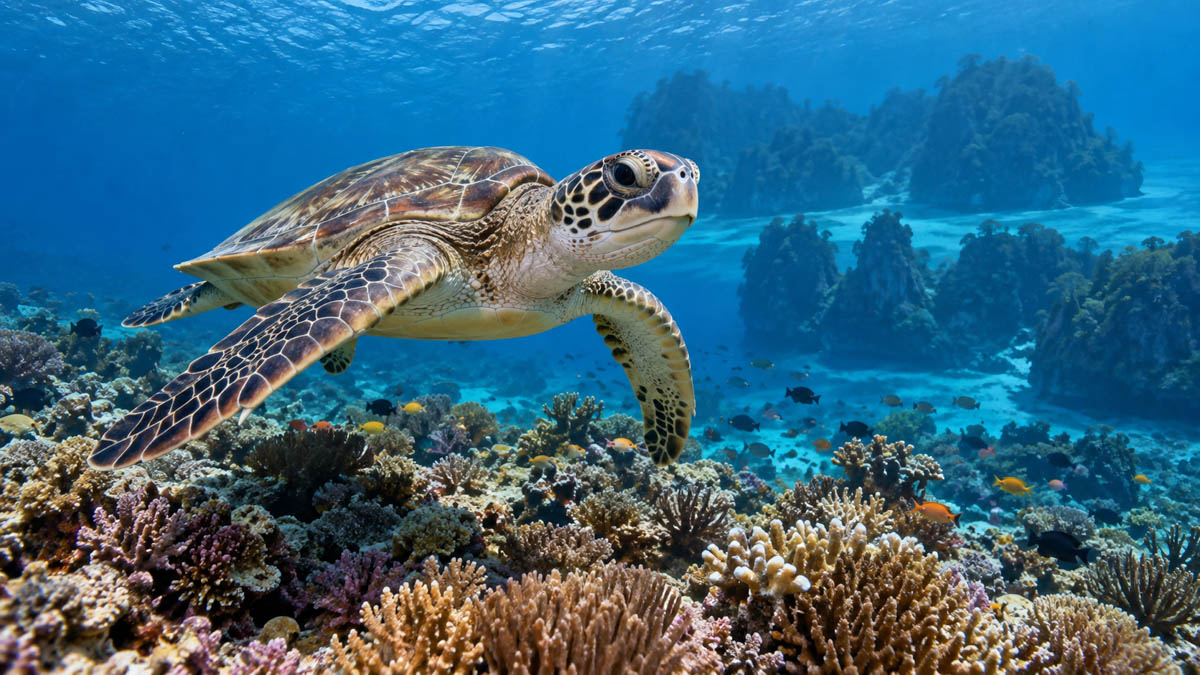

A foreign diver has been detained in Indonesia after allegedly killing a protected sea turtle with a speargun while diving in the waters of Raja Ampat.
The case has caused widespread anger within Indonesia’s diving and conservation communities after footage of the alleged incident circulated on social media.
Indonesian authorities have identified the detained man as Chinese national Wei Shang. He was reportedly stopped at Sultan Hasanuddin International Airport in Makassar after the Raja Ampat Regency Government formally requested that immigration authorities prevent him from leaving Indonesia.
According to CNN Indonesia, immigration officials identified his name on a passenger manifest and prevented his departure.
Makassar Immigration Office chief Abdi Widodo Subagio confirmed that the man had subsequently been detained by immigration officials.
The request followed reports of an alleged incident in the Piaynemo area of Raja Ampat, one of the world’s best-known marine environments and diving destinations.
Video Sparks Investigation
A short video circulating online appears to show a diver equipped with scuba equipment and a speargun approaching a turtle resting close to a coral reef before apparently firing the weapon.
Local reports place the alleged incident between September 9 and 11, when the diver was believed to have been staying in Raja Ampat.
The controversy intensified after further images reportedly circulated showing what was claimed to be the turtle after it had been killed and cooked.
Those claims remain subject to investigation.
Raja Ampat authorities subsequently submitted a formal request to immigration officials on September 14, asking that Wei Shang be prevented from leaving Indonesia while the allegations were examined.
The request followed a report from the Meos Mansar customary community patrol concerning the suspected hunting of marine wildlife in the Piaynemo area.
Supporting material listed by the local government reportedly included photographs and video of spearfishing activity, documentation relating to the turtle, witness information, location details and identification material.
Crucially, the Raja Ampat Government also stressed that determining whether a criminal offence has occurred remains the responsibility of law enforcement authorities following examination of the evidence.
Authorities Call For Transparent Investigation
Hasan Makassar, head of the Raja Ampat marine conservation area management unit, has called for the case to be investigated fully and transparently.
According to local reporting from Raja Ampat, conservation officials have been coordinating with fisheries, tourism, police and immigration authorities.
The detained diver was expected to be returned towards Sorong for further investigation.
Hasan said the case went beyond a simple breach of tourism rules because it potentially involved a protected species inside a marine conservation area.
Authorities have also raised concerns about the use of spearguns within protected waters.
Perhaps more concerning for the wider diving industry, Hasan said conservation authorities had previously encountered tourists bringing spearguns into the region and had already worked with tourism operators to improve awareness and supervision.
Why Raja Ampat’s Turtles Matter
Raja Ampat’s reputation has been built around an extraordinary marine ecosystem that attracts divers from across the world.
Indonesia’s official tourism information describes the region as containing around 75 percent of the world’s coral species, while its reefs provide habitat and protection for an enormous variety of marine life. Indonesia’s official tourism portal describes those ecosystems as fundamental both to marine biodiversity and local livelihoods.
Sea turtles are an important part of that environment.
Raja Ampat is known to support at least four of the world’s seven marine turtle species, including green and hawksbill turtles, while the wider Bird’s Head region is also important for leatherback turtles.
All sea turtle species occurring in Indonesian waters are protected under national conservation legislation.
That makes the allegations particularly serious in a destination whose international tourism economy depends heavily upon the health of the very marine environment visitors travel there to experience.
A Wider Question For Dive Tourism
The incident also presents an uncomfortable question for the international diving community.
Raja Ampat is not simply another place to go diving. Its global reputation exists precisely because generations of local communities, conservation organisations, government agencies and responsible tourism businesses have worked to protect an exceptionally valuable marine environment.
Visitors entering those waters inherit a responsibility to respect them.
The swift response from local communities is therefore significant. The initial demand for action came in part from customary community patrols, before conservation officials, local government, police and immigration authorities became involved.
For an industry increasingly dependent on healthy marine environments, incidents such as this are not separate from dive tourism. They strike directly at the resource upon which dive tourism depends.
The investigation is continuing, and no final determination of criminal responsibility has yet been announced.
The Scuba News will follow the case as Indonesian authorities determine what further action will be taken.
Comments